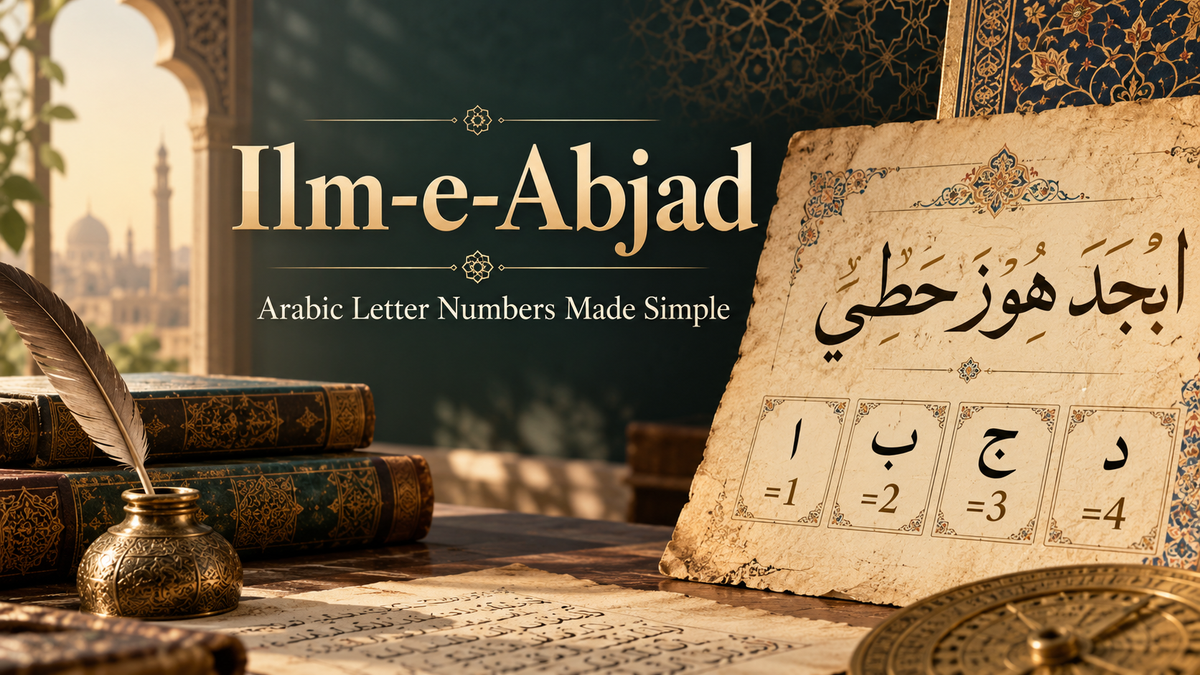
Have you ever heard someone say, “This name has the number 92” or “The Abjad value of this word is 256”?
You might wonder: How can a name have a number?
The answer is a traditional letter-number system called Ilm-e-Abjad.
In this system, every letter of the classical Arabic alphabet has a numerical value.
For example:
- Alif (ا) = 1
- Ba (ب) = 2
- Jim (ج) = 3
- Dal (د) = 4
When we add the values of the letters in a word, we get its Abjad total.
It is simple addition, but the system has a long history in Arabic, Persian and Urdu literature.
In this beginner-friendly guide, you will learn what Ilm-e-Abjad means, how its numbers work, and how to calculate words and names yourself.
We will use easy examples throughout.
1. What Is Ilm-e-Abjad?
Ilm-e-Abjad is the study and use of numerical values assigned to Arabic letters.
It is closely connected with a traditional calculation method called Hisab al-Jummal, also known as Hisab-e-Jumal or حسابِ جمل.
The main idea is very simple:
Every letter has a number. Add the letter numbers to find the total of a word.
Imagine that each letter carries a small number tag.
When you join letters together to make a word, you add their tags.
A very simple example
Take the Arabic word:
باب (Baab), meaning door.
It contains three letters:
- ب = 2
- ا = 1
- ب = 2
Now add them:
2 + 1 + 2 = 5
So, in the common Eastern Abjad system, the numerical value of باب is 5.
You have just completed your first Abjad calculation!
2. Why Is It Called Abjad?
The name comes from the first four letters of an old letter order:
ا ب ج د
These letters are read as Alif, Ba, Jim and Dal.
Together, they form the word Abjad.
The historical Abjad sequence begins:
ابجد هوز حطي كلمن سعفص قرشت ثخذ ضظغ
These groups helped learners remember the order of the letters.
This old arrangement is different from the modern Arabic alphabetical order used in many dictionaries and schools.
That difference is important.
For example, ت (Ta) may appear early in a modern alphabet lesson, but its traditional Eastern Abjad value is 400, not 3.
3. Abjad-e-Kabir: Numerical Values of All 28 Letters
One widely used method is called Abjad-e-Kabir, or the major Abjad system.
In its common Eastern, or Mashriqi, form, the 28 classical Arabic letters have the following values.
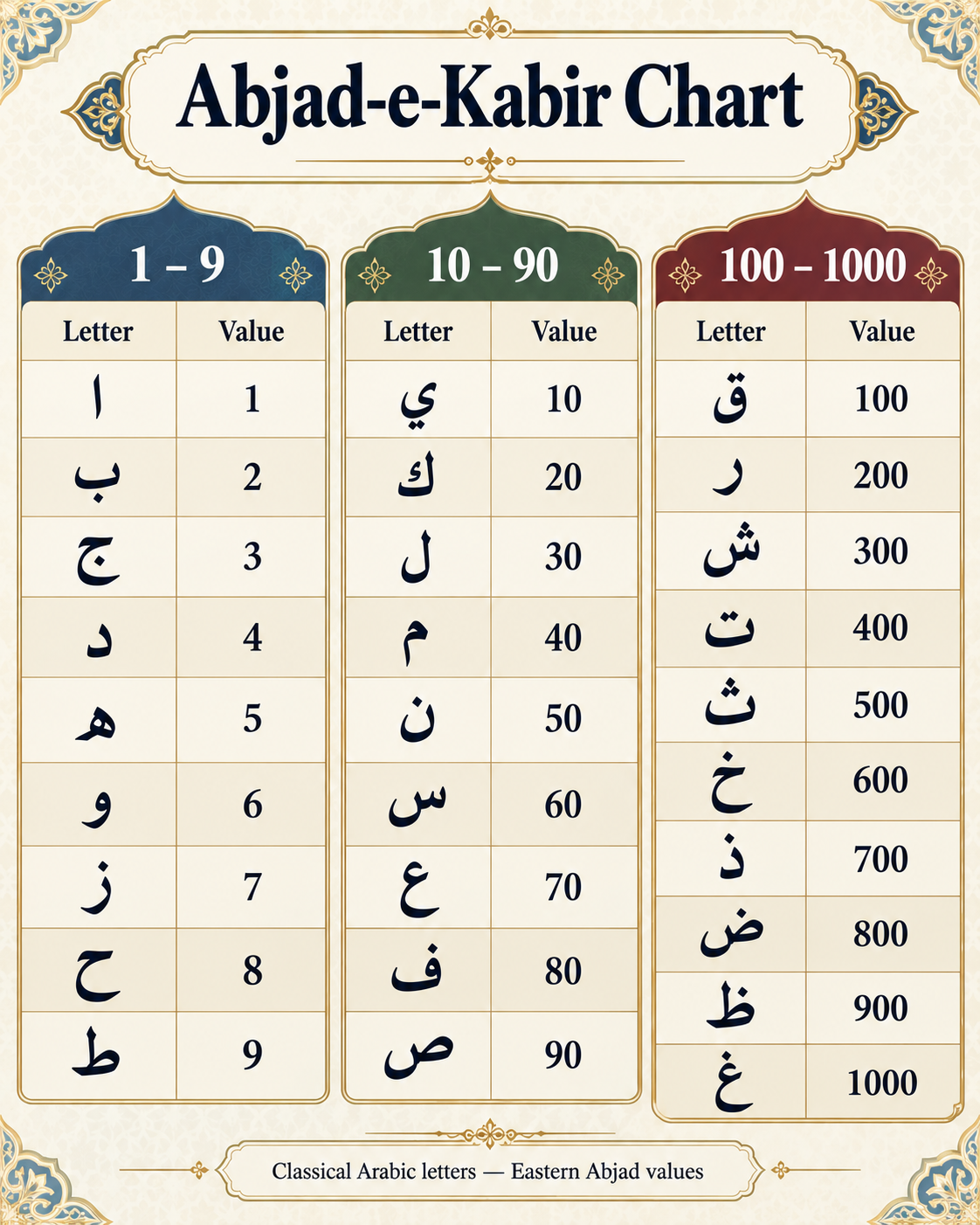
Letters from 1 to 9
- ا (Alif) = 1
- ب (Ba) = 2
- ج (Jim) = 3
- د (Dal) = 4
- ه (Ha) = 5
- و (Waw) = 6
- ز (Zay) = 7
- ح (Haa) = 8
- ط (Taa) = 9
Letters from 10 to 90
- ي (Ya) = 10
- ك (Kaf) = 20
- ل (Lam) = 30
- م (Mim) = 40
- ن (Nun) = 50
- س (Sin) = 60
- ع (Ayn) = 70
- ف (Fa) = 80
- ص (Sad) = 90
Letters from 100 to 1000
- ق (Qaf) = 100
- ر (Ra) = 200
- ش (Shin) = 300
- ت (Ta) = 400
- ث (Tha) = 500
- خ (Kha) = 600
- ذ (Dhal) = 700
- ض (Dad) = 800
- ظ (Zaa) = 900
- غ (Ghayn) = 1000
You do not need to memorize every value immediately.
For a beginner, it is enough to understand how to look up a letter and add its value.
Important: These are Eastern Abjad values. A historical Western, or Maghribi, system assigns different values to some letters.
4. How to Calculate a Word Using Abjad
You can calculate a word in four steps.
Step 1: Write the word in Arabic or Urdu script.
Step 2: Separate its letters.
Step 3: Find the numerical value of each letter.
Step 4: Add all the values.
Let's try a few examples.
5. Example: Calculate the Word Noor (نور)
Noor means light.
The word is written:
نور
It contains three letters:
- ن (Nun) = 50
- و (Waw) = 6
- ر (Ra) = 200
Add them:
50 + 6 + 200 = 256
The Abjad value of نور is 256.
Notice something interesting: a word with only three letters can have a large total.
That is because some Abjad letters have values of 100, 200 or even 1000.
6. Example: Calculate the Name Ali (علی)
Now let's calculate a familiar name.
علی (Ali)
Its letters are:
- ع (Ayn) = 70
- ل (Lam) = 30
- ی (Ya) = 10
Add them:
70 + 30 + 10 = 110
The name علی has an Abjad value of 110 under the stated letter-mapping convention.
This is a numerical result based on its spelling.
It does not tell us the person's character, luck or future.
7. Example: Why Is Muhammad (محمد) Equal to 92?
Another commonly discussed example is the name:
محمد
Let's calculate it carefully:
- م (Mim) = 40
- ح (Haa) = 8
- م (Mim) = 40
- د (Dal) = 4
Now add:
40 + 8 + 40 + 4 = 92
Therefore, the Abjad value of the written name محمد is 92 in the Eastern system.
Notice that the letter م appears twice.
We count it twice because it appears twice in the written word.
The arithmetic can be checked by anyone who knows the letter values.
However, the numerical result alone does not prove any supernatural property or prediction.
8. What Does the Number 786 Mean?
In parts of South Asia, the number 786 is sometimes associated with the phrase:
بسم الله الرحمن الرحيم
Why?
Because, using a commonly followed Eastern Abjad spelling convention, the written letters add up to 786.
Here is the calculation:
بسم
ب (2) + س (60) + م (40) = 102
الله
ا (1) + ل (30) + ل (30) + ه (5) = 66
الرحمن
ا (1) + ل (30) + ر (200) + ح (8) + م (40) + ن (50) = 329
الرحيم
ا (1) + ل (30) + ر (200) + ح (8) + ي (10) + م (40) = 289
Now add the four totals:
102 + 66 + 329 + 289 = 786
This explains how the traditional number is obtained.
But there is an important distinction: 786 is a calculated numerical total, not the Arabic text of Bismillah itself.
Using the number and reciting or writing the complete religious phrase are different actions. Questions about religious permissibility or practice should be referred to qualified religious scholars rather than decided from the arithmetic.
9. Where Was Abjad Used Historically?
Abjad was not originally just about people's names.
Its history includes practical and literary uses.
Writing numbers with letters
Before modern numeral notation became widespread, letters could be used to represent numbers in manuscripts, mathematical works and astronomical tables.
Recording dates in poetry
Some Arabic, Persian and Urdu poets created phrases whose Abjad totals matched a particular year.
This literary technique is called a chronogram, or Madda-e-Tareekh in Persian and Urdu usage.
For example, a poet might choose a phrase whose letters add up to a year connected with the construction of a building or the death of an important person.
This is a form of literary number design.
It does not mean the phrase predicted the event.
Traditional letter symbolism
Some historical mystical and spiritual traditions also assigned symbolic meanings to letter values.
Those interpretations are part of cultural and religious history, rather than results demonstrated by modern experimental science.
10. Do Urdu and Persian Letters Have Abjad Values?
The classical system was built around 28 Arabic letters.
But Urdu and Persian include additional letters, such as:
- پ
- چ
- ژ
- گ
- ٹ
- ڈ
- ڑ
These letters are not part of the original 28-letter Abjad table.
Historical sources and later calculation traditions do not always handle them in exactly the same way.
For example, some modern calculators assign:
- پ the value of ب, which is 2.
- چ the value of ج, which is 3.
- گ the value of ك, which is 20.
But this is a convention used by certain systems, not a universal rule found in every historical Abjad source.
If you calculate an Urdu or Persian name, always check which rules are being followed for letters outside the classical Arabic alphabet.
11. Why Do Two Abjad Calculators Sometimes Show Different Results?
Imagine you enter the same name into two websites.
One shows a total of 110, while another gives a different result.
Does that mean Abjad arithmetic is unreliable?
Not necessarily.
The websites might be following different counting rules.
Differences may come from:
- Eastern (Mashriqi) versus Western (Maghribi) Abjad values
- Different spellings of a name
- How additional Urdu or Persian letters are handled
- Whether certain forms of Hamza are counted separately
- How the letter ة is treated
- How written vowel marks or doubled-letter marks are handled
A simple spelling example
We already calculated:
نور = 256
Now add an Alif at the end:
نورا
The extra ا has a value of 1.
So:
256 + 1 = 257
Only one written letter changed, but the total changed too.
This is why the exact written spelling matters.
When two calculators disagree, first compare their rules and the written letters before assuming there is an error.
12. What Is the Difference Between Abjad-e-Kabir and Abjad-e-Saghir?
Abjad-e-Kabir commonly refers to the full numerical values listed earlier, from 1 to 1000.
Abjad-e-Saghir is a term used for smaller or reduced numerical methods in certain later traditions.
However, there is not just one universally followed reduction rule across every school.
For beginners, the safest approach is to first learn Abjad-e-Kabir and state clearly which system is used.
When studying another method, check its specific calculation rules rather than assuming all books or calculators follow the same procedure.
13. Is Ilm-e-Abjad the Same as Ilm-e-Jafr?
Not exactly.
Ilm-e-Abjad provides a way to assign numbers to letters.
Ilm-e-Jafr refers to a broader collection of traditions associated with letters, numbers and symbolic interpretation.
Different historical and spiritual schools describe Jafr differently.
Abjad values may be used within some of those practices, but knowing the value of a name is not the same as understanding every technique associated with Jafr.
Similarly, Ilm-e-Takseer involves additional traditional methods of working with letter arrangements.
These subjects have separate histories and rules.
A beginner should learn basic letter values before attempting to understand more complex traditional systems.
14. Can Abjad Numbers Reveal Someone's Future?
A word's Abjad total is obtained through addition.
That arithmetic is verifiable.
However, claims that a name's number reveals someone's destiny, determines marriage compatibility, identifies illness or guarantees wealth are different claims.
There is no established scientific evidence that a person's Abjad total can reliably predict those outcomes.
Two people with the same written name can have the same Abjad value and still live very different lives.
Their personal circumstances, choices, health, relationships and opportunities are not determined by a letter-number total.
Ilm-e-Abjad can be studied as a historical, literary and traditional calculation system without treating numerological predictions as established facts.
15. Practice: Try These Abjad Calculations
Before checking the answers, try calculating these words yourself using the Eastern Abjad table.
Question 1: علم (Ilm, meaning knowledge)
Letters: ع + ل + م
Answer:
70 + 30 + 40 = 140
Question 2: قلم (Qalam, meaning pen)
Letters: ق + ل + م
Answer:
100 + 30 + 40 = 170
Question 3: باب (Baab, meaning door)
Letters: ب + ا + ب
Answer:
2 + 1 + 2 = 5
Question 4: نور (Noor, meaning light)
Letters: ن + و + ر
Answer:
50 + 6 + 200 = 256
If you understood these four examples, you already know the basic method of Abjad calculation.
16. Frequently Asked Questions
Is Ilm-e-Abjad difficult to learn?
No. The basic calculation involves looking up letter values and adding them. Advanced historical or symbolic methods are separate subjects.
How many letters are in the classical Abjad system?
The familiar Arabic Abjad system uses 28 letters.
Are Abjad and modern alphabetical order the same?
No. Abjad uses an older letter sequence.
What is the value of Muhammad in Abjad?
For the spelling محمد, the Eastern Abjad total is 92.
What is the value of Noor in Abjad?
For the spelling نور, the Eastern Abjad total is 256.
Why can two people have the same Abjad number?
Different names can produce the same total because different combinations of letter values can add up to the same number.
Does the Abjad value of a name change with spelling?
Yes. Adding, removing or changing a written letter can change the numerical total.
Is Abjad a scientifically proven method of predicting the future?
No. Its arithmetic is straightforward, but personal predictive claims based on Abjad totals have not been scientifically established.
Final Thoughts
Ilm-e-Abjad is a traditional system that connects letters with numbers.
Its basic rule is easy to learn: find each letter's value and add the values together.
The system has historical connections with manuscripts, mathematics, poetry, dates and traditional letter symbolism.
For a beginner, the most important lessons are to use the correct letter table, pay attention to spelling, and understand that different Abjad conventions exist.
And remember: a correct number calculation does not automatically make a traditional interpretation scientifically true.
At RohaniGuide, our goal is to explain historical and traditional knowledge in a clear, respectful and easy-to-understand way, so readers can learn the methods and their limitations for themselves.