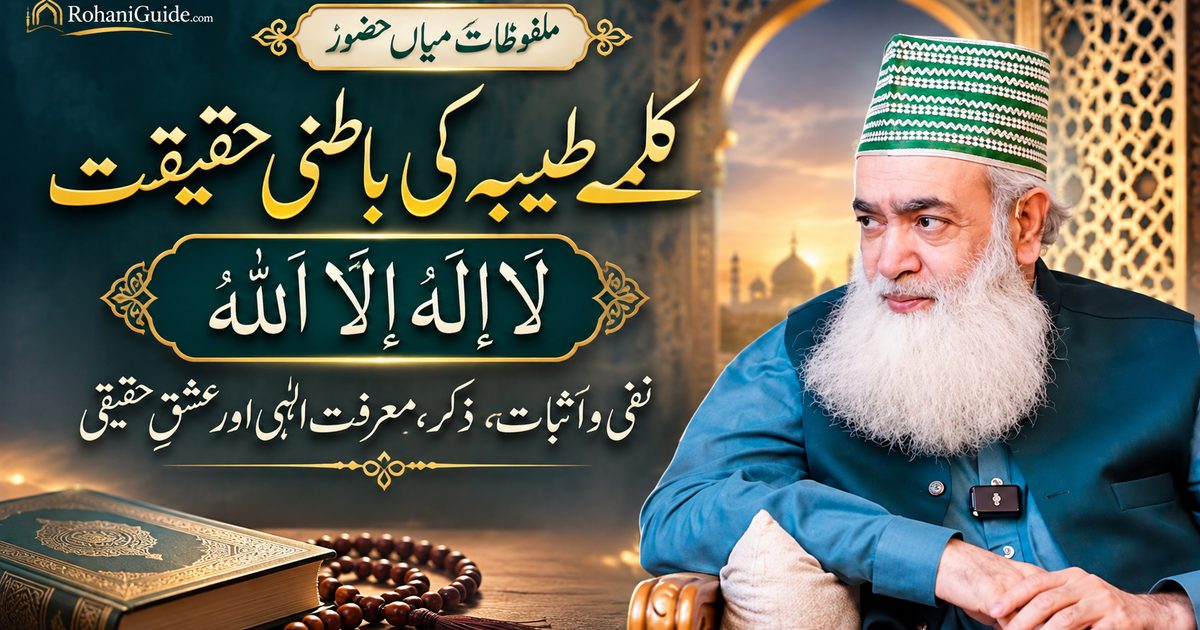
Reflecting on the spiritual teachings of Miyan Huzoor, Hazrat Hakeem Sufi Sheikh Tariq Ahmed Shah Arif
How many times has a person uttered La ilaha illallah in a lifetime? We learn it as children, repeat it in prayer, and return to it in moments of gratitude, anxiety, and remembrance. Yet the kalimah raises a question more searching than a mere count of its repetitions: What happens inside us when we say it?
In the discourse of Miyan Huzoor, the declaration of divine oneness is not treated as a sentence detached from life. It becomes a way of examining desire, pride, attachment, worship, attention, love, and the long journey toward knowing the One we worship. A question stands at the heart of his teaching: If the one true God is already One, why does the declaration begin with negation? What must be denied before the heart can truly affirm?
What follows is an arranged exploration of the ideas, analogies, spiritual terminology, and stories from the discourse shared for this article. It retains the speaker's central concern: not a new meaning that replaces the creed, but an inward engagement with the creed's power to shape human life.
Why does the kalimah begin with “La”—a negation?
The words لا إله إلا الله — La ilaha illallah deny all false objects of worship and affirm that only Allah is worthy of worship. Miyan Huzoor takes the listener from that familiar foundation to a more intimate question: does a person always recognize the things to which he has surrendered his will?
An individual may never bow before a physical idol and yet become helpless before an appetite, ambition, or craving for recognition. He may verbally acknowledge Allah's authority while allowing pride or fear to govern his choices. The heart can therefore harbour a kind of hidden allegiance that is not evident from outward words alone.
Miyan Huzoor speaks of the “possible object of worship” (ma‘bud-e-imkani) to describe this inner danger: something created or contingent that a person elevates until it dominates desire and obedience. His expression does not establish another true deity. It points to the human tendency to grant an undeserved place of authority to what can never be the ultimate source of life or meaning.
The Qur'an declares: لَيْسَ كَمِثْلِهِ شَيْءٌ وَهُوَ السَّمِيعُ الْبَصِيرُ — “There is nothing like Him, and He is the All-Hearing, All-Seeing.” Qur'an 42:11. If the Creator is without equal, then no possession, influence, fear, status, or desire deserves to sit beside Him in the heart as an ultimate master. For Miyan Huzoor, “La” is where that awakening begins.
Rejecting taghut: the struggle that takes place within
A verse repeatedly invoked in the discourse is:
فَمَنْ يَكْفُرْ بِالطَّاغُوتِ وَيُؤْمِنْ بِاللَّهِ فَقَدِ اسْتَمْسَكَ بِالْعُرْوَةِ الْوُثْقَىٰ لَا انْفِصَامَ لَهَا
Whoever rejects taghut and believes in Allah has grasped the firmest handhold, one that does not break. — Qur'an 2:256
Negation and affirmation appear here as two dimensions of the same movement. Miyan Huzoor places particular emphasis on the inward struggle. Taghut, in the broad language of the verse, concerns false authority and what is followed in opposition to Allah; the discourse asks the listener to notice how the ego can take on a tyrannical role within his own life.
He turns to the Qur'anic account of Iblis. When the command concerning Adam was given, the Qur'an describes Iblis as one who refused and became arrogant: أَبَىٰ وَاسْتَكْبَرَ. Qur'an 2:34. In Miyan Huzoor's reflection, the matter reaches beyond an isolated outward act to the inward insistence of the self: I am superior; my judgment must prevail.
It is easy to see this failing in another person. The difficult work is to ask, What demand of my own ego do I keep obeying even when it takes me away from my Lord? This inquiry is meant for self-examination, not for distributing verdicts about other people.
A whole lifetime between denial and affirmation
Among the discourse's most memorable ideas is the sense that the stations of spiritual travel unfold through “La,” and that an entire life passes in the work of negation and affirmation.
A person may overcome an obvious temptation and still be held by a subtler attachment. Having escaped one habit, he may become attached to his reputation for piety. Having gained knowledge, he may begin to admire his knowledge more than the truth it was meant to serve. What once seemed like an attainment can become an obstacle when the heart makes it its final destination.
Miyan Huzoor explains this progress using the spiritual vocabulary of nafs al-ammarah, nafs al-lawwamah, nafs al-mutma'innah, radiyah, and mardiyyah. In his teaching, movement toward a higher state requires leaving behind the lower inward tendency: heedlessness yields to self-reproach, inner agitation is met by greater peace, and the seeker learns the language of acceptance and contentment.
The Qur'an addresses the tranquil soul: يَا أَيَّتُهَا النَّفْسُ الْمُطْمَئِنَّةُ ارْجِعِي إِلَىٰ رَبِّكِ رَاضِيَةً مَرْضِيَّةً — “O tranquil soul, return to your Lord, pleased and pleasing.” Qur'an 89:27–28.
The crucial question is not simply how many stations a person can name. It is whether anything within him is actually changing. What am I leaving today, and toward what truth am I turning? In this reading, a word uttered in a moment may open the work of an entire lifetime.
Body, spirit and self: the example of sugar and water
Miyan Huzoor offers a strikingly simple analogy. A bowl of sugar and a glass of water are separate and recognizably different. When sugar dissolves in the water, a new experience appears: sweet water, a drink with a distinct quality. The drinker does not experience the dry sugar and plain water as isolated things; he encounters their joined condition.
He uses this illustration to speak about the human self in the meeting of body and spirit. His concern is to make the conflict between inward aspiration and bodily desire easier to understand. The nafs becomes the scene in which fear, longing, choice, discipline, and the struggle between what elevates a person and what draws him downward are experienced.
He also employs the language of the world of creation (khalq) and the world of command (amr). Our immediate environment captures attention: what we earn, touch, lose, fear, and possess can become all-consuming. The visible gift may command such intense affection that we forget the Giver.
The point is not to despise creation. It is to recover a right relationship to it: from gift to Giver, from appearance to meaning, from possession to gratitude. The same world can be lived in with a very different centre of attention.
The covenant of Alast: remembrance before forgetfulness
The Qur'an recounts the covenantal question: أَلَسْتُ بِرَبِّكُمْ قَالُوا بَلَىٰ — “Am I not your Lord?” They answered, “Yes.” Qur'an 7:172.
Miyan Huzoor introduces the covenant as a question about recognition. His discourse draws a connection between the soul's acknowledgement of its Lord and the human being's later struggle in the world of desire. The path of remembrance can then be imagined as a return toward a relationship that heedlessness has obscured.
The declaration La ilaha illallah is thus more than an unfamiliar sentence learned from outside. It invites us to renew the question of belonging: Who is my Lord? For whom am I living? What stands at the centre of my love?
If Allah needs nothing, what is the deeper purpose of worship?
In an everyday comparison, Miyan Huzoor asks why a shopkeeper honours his customers. The customer is necessary to the shopkeeper's business, so care and courtesy can also serve an expectation of gain. Much of human interaction is mixed with need.
But Allah's relationship with His creation cannot be understood as a trade in which He requires our worship to complete Himself. He was the Lord before we were here, and He will remain the Lord when we are no longer here. The Qur'an says: إِنَّ اللَّهَ لَغَنِيٌّ عَنِ الْعَالَمِينَ — Allah is free of need of all worlds. Qur'an 29:6.
The spiritual force of the comparison is not to belittle prayer, remembrance, or obedience. It is to ask whether we reduce worship to a transaction. Do we turn toward Allah only to obtain a particular benefit, or do we also long to know Him, remember Him, and love Him because He is our Lord?
Worship and gnosis are not rivals here. Worship is expressed through submission and action; ma'rifah gives inward presence, awareness, and love a greater place within that submission. The seeker is not told to abandon religious practice. He is invited to inhabit it more deeply.
Paradise, fear, hope—and love of the Lord Himself
Human beings are often moved by fear of harm or hope of reward. Miyan Huzoor uses the example of traffic rules: where a penalty is immediate and certain, people more readily obey; where they feel no consequence, they can become careless. The illustration introduces an honest question about intention.
A person may pray while fearing punishment. Another may pray in hope of Paradise. Both fear and hope have their places in religious life. But can one also worship out of love for Allah Himself? Can the heart look beyond the reward toward the One who grants it?
To clarify the difference, Miyan Huzoor imagines three visitors approaching a ruler. One arrives because he is afraid. Another hopes to receive a favour. The third is moved by sincere affection. Outwardly, all three enter the same court; inwardly, their reasons are quite different.
One of the discourse's most memorable reflections can be rendered this way: “I was not made for Paradise alone; Paradise is a gift for me, but I belong to my Lord.” This is not a rejection of Paradise. It is the insistence that love for the Giver can be more central than desire for the gift.
The point is intimate and searching. A seeker can be grateful for mercy, ask for blessing, and hope for reward—while making the relationship with Allah the most precious part of every hope.
Dhikr with reflection: when words have an inner meaning
The discourse then turns directly to remembrance of Allah. Reciting La ilaha illallah is an act of worship in itself, yet Miyan Huzoor presses the listener to ask whether the heart is awake to what the tongue is saying. Speech carries meaning; remembrance can become more inwardly attentive when the person understands and contemplates its declaration.
He describes “La” as a moment of negation: my ego is not ultimate, my ambitions are not divine, the world is not eternal, and no passing condition deserves absolute allegiance. Then “illallah” turns attention to the One who remains.
The Qur'an expresses the contrast with particular beauty:
كُلُّ مَنْ عَلَيْهَا فَانٍ وَيَبْقَىٰ وَجْهُ رَبِّكَ ذُو الْجَلَالِ وَالْإِكْرَامِ
Everyone on earth passes away, while your Lord—Lord of Majesty and Honour—remains. — Qur'an 55:26–27
This does not mean abandoning work, family, lawful enjoyment, or responsibility. It means keeping all these things in their proper place. We may love the world as a trust and an opportunity, without enthroning it in the heart.
Miyan Huzoor uses a deliberately sharp proverbial comparison about remembrance without reflection. Its purpose is to shake the listener from automatic repetition and remind him that inward alertness, attention, and intention matter. The difference he wants us to notice is not simply between silence and speech, but between habitual speech and living remembrance.
Fana and baqa: a contemplative movement through the kalimah
As the listener contemplates “La,” the speaker invites the imagination to loosen its hold on things that pass away. As attention turns to “illallah,” the heart remembers the abiding reality of the Creator. Miyan Huzoor frames this as a movement from negation to affirmation, and from awareness of the transient to remembrance of the Everlasting.
He also compares the dissolving of inward attachment to the intensity of a fire that can consume what it reaches. This is an emphatic image of transformation, not an instruction to cause physical destruction. The real question is whether we are prepared to stop preserving what distances us from Allah as the centre of our life.
A sacred hadith speaks of the closeness of remembrance: “I am as My servant thinks of Me ... and I am with him when he remembers Me.” Sahih al-Bukhari 7405. In this context, hope in Allah, remembrance, and conscious turning toward Him illuminate one another.
The Prophet Muhammad ﷺ is also reported to have said: أَفْضَلُ الذِّكْرِ لَا إِلَهَ إِلَّا اللَّهُ — “The best remembrance is La ilaha illallah.” Jami' at-Tirmidhi 3383. Miyan Huzoor's reflections explore why a declaration that speaks of every false attachment and the one true God can carry such significance throughout a human life.
The blue spectacles: what changes when the way of seeing changes?
Imagine that someone puts on blue-tinted glasses. The world begins to look blue to him, although it does not look blue to everyone else. The difference is not necessarily in the objects themselves. It is in the condition through which the observer is seeing them.
Miyan Huzoor offers this image to explain the transforming effect of ma'rifah, or spiritual recognition. When a person sees everything through appetite, rivalry, greed, and fear, the world seems to revolve around possession and loss. When remembrance and gratitude shape his inward perspective, the very same events can invite a different response.
This is not an assertion that Creator and creation become identical. It is the experience that created things can become reminders of the Creator. A meal calls forth thanks. A relationship becomes a trust. A moment of beauty awakens humility. An achievement becomes an occasion not only for pleasure but also for remembrance.
The world need not disappear for its meaning to change. The heart can learn to look through the world without stopping at the world.
Ihsan: worship as though you see Him
From the discussion of inner perception, the discourse reaches the famous Hadith of Jibril. When asked about ihsan, the Prophet Muhammad ﷺ explained that it is to worship Allah as though you see Him; and if you do not see Him, to know that He sees you. Sahih al-Bukhari 50.
What does “as though” mean when Allah is not encompassed by ordinary vision? The Qur'an says: لَا تُدْرِكُهُ الْأَبْصَارُ وَهُوَ يُدْرِكُ الْأَبْصَارَ — “No vision can encompass Him, but He encompasses all vision.” Qur'an 6:103.
For Miyan Huzoor, the question turns us toward inward sight: certainty, presence of heart, and attentiveness before the Lord. One need not invent an image of Allah. One is invited to worship with an awareness so real that heedlessness begins to recede.
And when that degree of attentiveness feels beyond reach, the second part of the Prophetic teaching remains open to every worshipper: He sees you. That conviction can enter prayer, dealings with others, private choices, repentance, and gratitude. Ihsan becomes less a passing emotion than an orientation of the whole life.
The blessed shadow and a story of concealment in “La”
Miyan Huzoor's discourse includes a contemplative reflection on the blessed shadow of the Prophet ﷺ. The spiritual point he develops is about the limitations of human perception. He uses the language of visibility and concealment to bring the listener back to awe before the One whom sight cannot encompass.
He then narrates a spiritual story concerning Imam Husayn (may Allah be pleased with him) and Khidr (peace be upon him). In the story as told in the discourse, Imam Husayn conceals himself in “La,” while Khidr searches and cannot find him. The image conveys the inner themes of negation, concealment, and the surrender of outward self-importance.
These episodes belong to the illustrative and narrative register of the discourse. The central thread remains unchanged: the seeker should not mistake the limits of what can be seen for the limits of what can be understood through remembrance, awe, and the search for the divine.
La, Illa, Allah and Hu: symbolic stations of the spiritual path
Toward the end of the recorded discussion, Miyan Huzoor relates stages of remembrance to the language of nasut, malakut, jabarut, lahut, and hahut, and to the lata'if or subtleties of the inner life. He also observes that different spiritual teachers describe the relations between fana and baqa in different ways.
The following table presents the associations discussed in this discourse, not a universally fixed linguistic definition or a replacement for the ordinary meaning of the kalimah.
| Remembrance or sign | Spiritual association in the discourse | Central inward concern |
|---|---|---|
| La | Nasut, the nafs, negation | Refusing egoic self-exaltation and false allegiance |
| Illa / Ilah | Malakut, the heart, worship | Obedience, discipline, the cultivation of the heart |
| Illallah | Jabarut, the spirit, witnessing | Affirmation, inward presence, deepening recognition |
| Allah | Lahut, the sirr, signs of abiding | Concentrating attention upon the true Beloved |
| Hu | Hahut, the akhfa, signs of self-effacement | Quieting pretension and the demand to be noticed |
The value of the map is not in collecting impressive words. It lies in remembering that the human heart must also undertake a journey while the tongue speaks. A form of remembrance may expose the ego; another contemplation may awaken gratitude; deeper attention may make the seeker less fascinated by his own apparent achievements.
Miyan Huzoor includes the evocative image of an “empty settlement” for a state in which self-display and boastful claims fall silent. Read in the language of spiritual symbolism, the point is not to claim divine status for the seeker. It is to awaken a more complete recognition of one's servanthood.
One lifetime, one continuing question
If the discourse were reduced to one practical question, it would be this: Whom do I affirm with my tongue, and whose command do I follow in my decisions?
The spiritual journey unfolds amid ordinary duties: earning a living, caring for family, keeping promises, praying, giving thanks, and doing what is right. Its significance is not restricted to moments of seclusion. Miyan Huzoor's challenge is to bring the meaning of the kalimah into this everyday life.
“La” teaches us to question the claims of what cannot be our ultimate master. “Illallah” brings the heart back to the One who is. Dhikr reminds; reflection seeks meaning; striving against the ego asks us to change; love takes us beyond mere bargaining; and ihsan teaches us to live with awareness of the Lord who sees us.
The aim is not merely to pronounce the declaration correctly. It is to let its truth shape a life.
Frequently asked questions
Why does La ilaha illallah begin with negation?
It rejects every false object of worship and affirms Allah alone. Miyan Huzoor connects that order to the inward effort of renouncing the ego's unjustified authority over the heart.
What does ma'bud-e-imkani mean in the discourse?
It is a spiritual expression for a created or contingent attachment—especially an unruly ego—that a person allows to dominate his loyalties. It does not mean that there is another true God.
Why combine dhikr with reflection?
The discourse encourages an awareness of what the words mean. Recitation, attention, and an intention to live by the declaration can reinforce one another.
Does loving Allah mean one should not hope for Paradise?
No. The discourse recognises fear and hope while giving particular emphasis to love for the Giver beyond desire for the gift.
What does it mean that a lifetime is spent in “La”?
It means that self-examination and the leaving behind of false attachments is not a single event. As a seeker develops, subtler forms of attachment may also become visible.
What is ihsan in the Hadith of Jibril?
It is worshipping Allah as though one sees Him, and, if unable to sustain that awareness, remembering that Allah sees the worshipper. In Miyan Huzoor's discussion, this becomes a call to inner attentiveness and reverence.
Conclusion: from reciting the kalimah to living by it
A person may recite sacred words for years while still being driven by hidden fears and ambitions. Another may pause during remembrance and ask a question that changes his direction: For whom am I living? What do I truly seek?
This is the enduring power of the discourse. It moves from the tongue to the heart, from the heart to reflection, from reflection to self-discipline, and from discipline to ma'rifah and love. “La” weakens the grip of what is false; “illallah” recalls the heart to its true belonging.
La ilaha illallah: one declaration of faith, and a lifetime of returning to its meaning.
Sources and further reading
This article is an edited thematic presentation of the teaching shared from Miyan Huzoor's discourse. The following primary references were consulted for the Qur'anic passages and hadith quotations:
- Qur'an 2:256 — Rejecting taghut and the firmest handhold
- Qur'an 42:11 — There is nothing like Him
- Qur'an 7:172 — The covenant of Alast
- Qur'an 89:27–28 — The tranquil soul
- Qur'an 55:26–27 — What passes and what remains
- Qur'an 6:103 — Vision and divine encompassing
- Sahih al-Bukhari 50 — The Hadith of Jibril and ihsan
- Sahih al-Bukhari 7405 — “I am as My servant thinks of Me”
- Jami' at-Tirmidhi 3383 — The best remembrance