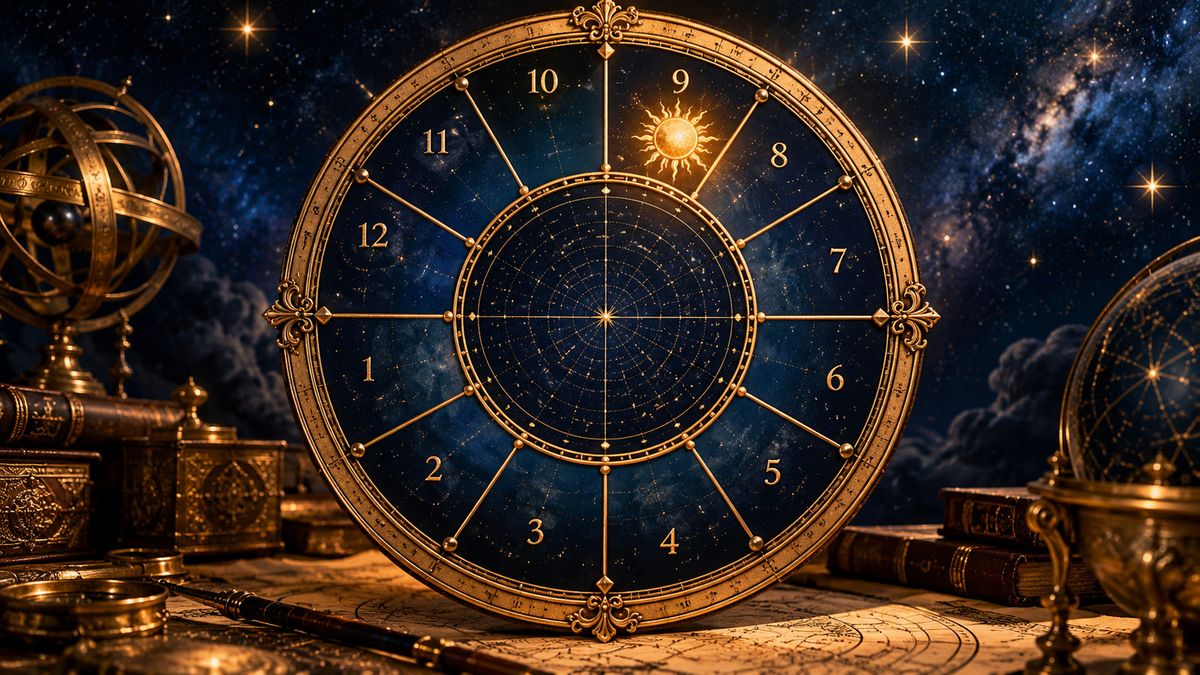
The Sun may occupy the same zodiac sign for many people born within a few weeks, yet appear in very different houses of their birth charts. This difference lies at the heart of a more individualised astrological reading. A Sun in Leo does not automatically mean a Sun in the fifth house; a Sun in the tenth house is not automatically in Capricorn. The sign and the house answer different questions.
In traditional astrological language, the Sun signifies light, honour, visibility, authority, vitality, and a person's desire to express a distinctive purpose. The house marks the domain of life in which these themes are interpreted. Thus the first-house Sun is traditionally read through self-presentation, the fourth-house Sun through roots and private foundations, and the tenth-house Sun through public responsibility. These are interpretive associations passed down through astrological traditions, not promises of events, fixed descriptions of personality, or knowledge of someone's unseen future.
This guide concentrates on the Sun in each of the twelve houses, with meaningful examples, historical distinctions, and the chart-reading steps that prevent oversimplification. If you are new to the houses themselves, begin with RohaniGuide's introduction to the twelve houses. Here, our question is more specific: what happens to the symbolism of the Sun when its house changes?
1. What Does the Sun Represent in a Birth Chart?
The Sun is a luminary rather than a planet in the present-day physical classification, although older astrological books customarily count it among the seven traditional “planets”. In those texts, its language is often royal: a lamp at the centre of attention, a figure of dignity, and an emblem of visible leadership. In personal birth-chart interpretation, later writers also associate it with conscious identity, initiative, pride, and the need to be recognised for one's contribution.
The historical writer William Lilly, as presented in Skyscript's annotated Sun significations, associated the Sun with rulers, magistrates, honour, and preferment. Modern explanations often place greater emphasis on identity and creative self-expression. Those emphases overlap, but they are not identical: historical status symbolism and modern inward interpretation should not be passed off as one unchanging ancient rule.
A useful image is a lamp shining through different windows. The lamp remains the Sun; the twelve windows correspond to different houses. Neither the lamp nor the window, alone, tells the whole story of the horoscope.
Sun sign, Sun house, and Ascendant: three separate things
| Chart factor | What is calculated | Traditional interpretive question |
|---|---|---|
| Sun sign | Zodiac sign containing the Sun | In what symbolic style is the Sun expressed? |
| Sun house | House containing the Sun under a chosen house system | In which life domain is the solar theme emphasised? |
| Ascendant | Zodiacal point rising at the eastern horizon | What anchors the chart's house framework? |
| Sun aspects | Angular relationships with other chart points and planets | How do other symbols qualify the reading? |
Our earlier guide to Sun, Moon and Rising signs explains the first and third factors. A house placement adds another layer. Two people can share the same Sun sign, yet receive different house-based descriptions because they were born at different times or places.
2. Sun in All Twelve Houses: Quick Reference
| House | Main traditional domain | Central solar theme | Question for reflection |
|---|---|---|---|
| First | Self, appearance, beginnings | Visible identity and personal initiative | Do I lead with confidence or with pride? |
| Second | Possessions, resources | Honour linked to stewardship and provision | Do my resources serve my values? |
| Third | Siblings, messages, journeys | A voice seeking recognition | Can I communicate without dominating? |
| Fourth | Home, parents, roots | Private foundations and family responsibility | What gives my inner life stability? |
| Fifth | Children, pleasure, creativity | Joy in expression and creative contribution | Can I create without constant applause? |
| Sixth | Service, toil, illness in older texts | Dignity amid everyday obligations | Do I value quiet service? |
| Seventh | Marriage, contracts, opponents | Identity encountered through partnership | Can I share recognition fairly? |
| Eighth | Shared wealth, inheritance, loss | Questions of control and trust | How do I respond to uncertainty? |
| Ninth | Learning, faith, long journeys | Purpose through knowledge and worldview | Does conviction leave room for humility? |
| Tenth | Honour, office, vocation | Public responsibility and reputation | What should my work stand for? |
| Eleventh | Friends, patrons, alliances | Leadership within networks and hopes | Do I strengthen the people around me? |
| Twelfth | Seclusion, hidden troubles, retreat | Inner life away from public display | Can I find worth without an audience? |
These entries are starting points, not automatic verdicts. A house cannot prove wealth, marriage, an illness, foreign travel, or professional success. Interpretation also varies between classical Western, modern Western, and Indian traditions.
3. Sun in the First House — Presence, Initiative and Identity
Traditionally the first house is the place of the person whose chart is being read. When the Sun occupies it, an astrologer may emphasise visibility, personal direction and the wish to stand on one's own feet. Such a reading often describes someone who wants a clear voice in decisions, dislikes being overlooked, or feels responsible for setting the tone.
The gift in this symbolism is initiative. An individual might be the first to volunteer, present a proposal, or take responsibility when a group hesitates. Its shadow is self-centredness: mistaking every disagreement for a challenge to one's standing. This is a question to explore, not a fixed judgment about anyone with the placement.
A first-house Sun is not the same as a Leo Sun. It can occur in many signs. Likewise, proximity to the Ascendant can matter: a Sun close to the rising degree may be interpreted differently from one farther away in the same house. A chart calculated from an uncertain birth time may change the answer altogether.
4. Sun in the Second House — Self-Worth, Wealth and Stewardship
The second house traditionally concerns movable possessions, resources, and the means by which someone supports a household. Here solar imagery turns to dignity in earning, keeping and using what one has. Some readings highlight the wish to be financially independent or to gain respect through competence and provision.
Imagine two approaches to the same inheritance. One person treats it as evidence of superiority; another sees it as a responsibility requiring careful management. This distinction illustrates the choice within the symbolism. The placement does not establish that either person will be rich.
A more subtle second-house Sun reading may ask whether a person confuses social worth with net worth. In some traditional accounts, the condition of the second-house ruler and related planets must be examined before claims about resources are attempted. No placement should be used to give guaranteed profit forecasts or investment instructions.
5. Sun in the Third House — Voice, Learning and Close Connections
The third house is linked in different traditions with siblings, messages, familiar travel, and everyday exchange. A Sun placed here is often read as a desire to be heard, to convey something useful, or to earn standing through skill with words.
The image need not be that of a famous speaker. It might be a teacher who patiently explains difficult ideas, a sibling who becomes the family spokesperson, or a neighbourhood organiser who is constantly asked for guidance. Each is an illustration of the theme, not a prediction drawn from a real birth chart.
The tension is between illumination and control. Does the person's voice help others understand, or must they always have the final word? Unlike popular sign-to-house shortcuts, the third house is not automatically Gemini, and the Sun does not become Mercury merely by appearing here. The Sun keeps its own symbolic role within the house's setting.
6. Sun in the Fourth House — Home, Ancestry and Private Foundations
The fourth house is associated with home, family roots, ancestry, and the base on which a life is built. A fourth-house Sun can be read as private duty, protection of the household, pride in heritage, or the wish to create a stable place of belonging.
Consider an individual who prefers building a modest, secure family enterprise to pursuing public applause. Within this symbolic reading, their sense of purpose grows through foundations rather than a public stage. Another person might feel the burden of being the relative everyone expects to hold the family together.
The shadow is not “family misfortune”; it is the possibility of tying one's whole identity to inherited expectations. In several quadrant systems, the IC is the fourth-house cusp. In Whole Sign houses, the IC can sit elsewhere within the chart, so “Sun in the fourth” and “Sun conjunct IC” are not synonyms. This distinction is explained further in Astrodienst's house-system reference.
7. Sun in the Fifth House — Creativity, Children and the Pleasure of Making
The fifth house traditionally addresses children, pleasure, celebration, love affairs, games, and what brings delight. With the Sun here, readers often highlight creative pride: wanting to make, teach, nurture, perform, or leave something distinctly one's own.
A person might find satisfaction in organising a community theatre, writing a story, coaching young people, or simply bringing warmth to family celebrations. The symbolic difficulty appears when every act of generosity silently demands appreciation. A creative life can flourish without treating praise as its only measure.
Two historical corrections matter. First, the Sun's traditional planetary joy is in the ninth house, not the fifth; Venus is associated with joy in the fifth. Second, Sun in the fifth does not establish fertility, the number of children, or a pregnancy outcome. Such predictions would go far beyond the evidence of a chart. See Deborah Houlding's study of planetary joys.
8. Sun in the Sixth House — Service, Duty and Invisible Work
Older Western astrological sources treated the sixth house as a difficult place linked with illness, labour, and service; many modern authors interpret it through routines and daily responsibilities. A sixth-house Sun can therefore be read as a search for dignity in necessary work that others barely notice.
Picture the administrator who keeps a hospital department organised, or the craftsperson who takes pride in dependable details. The solar theme is not fame, but the wish to do important work well. A possible inner conflict arises when a person keeps trying to prove their worth by becoming indispensable to everyone.
Classical authors counted the sixth among the cadent houses, generally weaker for conspicuous planetary expression. That historical technical description does not mean a person is weak, unlucky, or chronically ill. A natal chart cannot diagnose or predict an illness. The sixth-house interpretation remains a traditional symbolic reading, not a medical assessment.
9. Sun in the Seventh House — Partnership, Respect and the Mirror of Others
The seventh house is linked with marriage, partnerships, agreements, and openly declared opponents in classical texts. The Sun in this house can symbolise discovering one's identity through encounters with strong, significant others.
One interpretation emphasises a person who values a capable spouse or colleague; another asks whether the individual repeatedly gives away authority or competes with a partner for it. A useful illustration is two founders of a business who both deserve recognition: can each make room for the other's contribution?
A seventh-house Sun does not mean someone is destined to marry an influential person, face divorce, or enter a second marriage. Those claims are not justified by a single placement. The house is opposite the first, and the relationship between self and other gives this position its interpretive flavour. It is about negotiating visibility, not a guaranteed relationship outcome.
10. Sun in the Eighth House — Trust, Shared Obligations and Change
Historical interpretations of the eighth house often concern death, inheritances, and resources held or received through others. Many modern interpretations have shifted towards intimacy, shared obligations, and profound change. With the Sun here, a careful reading may explore what happens to personal pride when control, possessions or certainty must be shared.
An example might involve siblings administering an estate, or two partners deciding how to manage joint debt. The central issue is not whether their finances will improve, but how questions of trust and power colour the experience.
This house attracts sensational predictions, which are especially important to avoid. No Sun placement tells a person's date of death, lifespan, catastrophic future, or hidden tragedy. Differences between classical and modern interpretations should be acknowledged openly instead of merged into a dramatic story. The responsible reader treats this house's challenging language as symbolic and historically situated.
11. Sun in the Ninth House — Knowledge, Belief and the House of Solar Joy
In traditional Western astrology, the ninth is the house of the Sun's planetary joy. Deborah Houlding documents its links with religion, counsel, divination, higher understanding and the pursuit of truth. This is an actual historical doctrine, unlike the common internet shortcut that assigns the Sun to the fifth because Leo is the fifth zodiac sign.
A ninth-house Sun can be interpreted as a desire to give one's life direction through learning, teaching, ethical conviction or a broad view of the world. The emblematic figure might be a scholar who takes a difficult journey to study, or a mentor who spends years clarifying a tradition for students.
The balancing question is humility: does the desire to understand become a need to pronounce final judgments on everybody else? Nor does this placement guarantee an overseas journey, religious authority, or admission to a university. “House of joy” is a traditional technical affinity; it does not mean the person's life will contain uninterrupted happiness.
12. Sun in the Tenth House — Public Duty, Career and Reputation
The tenth is a major place of office, honour, authority, reputation and one's visible contribution to society. A tenth-house Sun is often interpreted as a desire to carry responsibility where others can see the outcome. This may involve leadership, skilled professional practice, public service, or simply wanting one's work to matter.
In an illustrative case, two employees receive the same promotion. One views it chiefly as a title; the other views it as an obligation to improve the team's work. The symbolism is richer when honour is understood as accountability, not merely applause.
The Sun here does not guarantee fame, government employment, wealth, or a promotion. The Midheaven (MC) is an important related point, yet in Whole Sign and Equal House charts it need not mark the tenth-house cusp. A precise reading should distinguish Sun in the tenth from Sun near the MC rather than using the phrases interchangeably.
13. Sun in the Eleventh House — Friendship, Support and Collective Purpose
In much traditional Western astrology, the eleventh is the place of good fortune, benefactors, friendship and hopes; modern accounts often stress groups and collective activity. When the Sun enters this symbolic domain, readers may describe a wish to contribute a recognisable role within a community or network.
The clearest version of the theme is not “everyone will admire you.” It is a coordinator whose leadership gives others room to do their best, or a patron who shares opportunities rather than hoarding credit. Solar warmth can be a form of generosity when it illuminates the group as well as the individual.
The shadow is depending too heavily on social approval or assuming every friendship must enhance one's status. Historically, Jupiter—not the Sun—has its planetary joy in the eleventh. This matters because the symbolism of an auspicious house should not be mistaken for a Sun-specific doctrine.
14. Sun in the Twelfth House — Seclusion, Hidden Burdens and Quiet Identity
The twelfth house carried difficult associations in traditional Western texts, including confinement, hidden opposition and withdrawal. Modern readings often explore privacy, retreat, solitude and work undertaken beyond the spotlight. A Sun here may symbolise the search for identity when recognition from the wider world is absent or deliberately set aside.
One picture is an anonymous donor, another a researcher who prefers working out of view. Their inner motives cannot be known from the birth chart; these are examples of how a modern reader might use the placement as a question about the value of unseen contribution.
A twelfth-house Sun is not evidence of black magic, mental illness, secret enemies, imprisonment, or divine favour. The older language should be explained responsibly rather than turned into fear. Saturn has its planetary joy in the twelfth in the classical scheme; this historical detail should not be repackaged as an unavoidable curse on anyone born with the Sun here.
15. Why Classical and Modern Interpretations Sometimes Disagree
Astrological house symbolism did not develop in a single uniform textbook. A classical reader might put greater weight on dignity, planetary sect, angularity, house rulers, and the older meanings of service or loss. A modern reader may highlight self-understanding, creativity, and psychological patterns. Indian Jyotisha uses the language of bhavas and may apply additional rules such as house lords and divisional-chart techniques.
| Reading dimension | A classical Western emphasis | A commonly modern emphasis |
|---|---|---|
| Solar meaning | Honour, authority, visibility, rank | Conscious identity, self-expression, purpose |
| Sixth house | Service, toil, illness as traditional topics | Routines, practical contribution, work-life habits |
| Eighth house | Inheritance, loss, matters of mortality | Shared power, intimacy, transformation |
| Twelfth house | Isolation, hidden adversity, confinement | Retreat, privacy, the unseen inner world |
| Ninth house | Religion, counsel, divination; the Sun's joy | Philosophy, higher learning, worldview |
This comparison explains variations between authors. It does not make either system a reliable instrument for deciding real-life outcomes.
Angular, succedent and cadent: does house strength matter?
Classical Western astrologers classified houses as angular (1, 4, 7, 10), succedent (2, 5, 8, 11) and cadent (3, 6, 9, 12). These labels describe a traditional hierarchy of how visibly or forcefully a planet was believed to act. They are not a ranking of people. The ninth can be cadent in this system and still be the Sun's house of joy; the terms describe different traditional considerations. For the historical framework, see Skyscript's angular, succedent and cadent discussion.
16. How to Find Your Sun's House Correctly
A birth date often allows an approximate Sun sign, but it does not usually establish a trustworthy Sun house. You need the date, local birth time, birthplace, correct time-zone history, zodiac setting and house system. This is why a website that asks only for your birthday cannot reliably give you a personalised Sun-in-house reading.
- Obtain the most reliable recorded birth time available, noting whether it is exact or approximate.
- Enter the birthplace and make sure the calculator uses the correct historical time-zone offset.
- Choose the zodiac and house system intentionally. Whole Sign, Equal House and Placidus are not interchangeable.
- Locate the Sun symbol (☉), then read the house number shown for that calculated chart.
- Recheck any planet near a house boundary, especially if birth time is uncertain.
- Only then interpret the house together with the Sun's sign, aspects, and other relevant chart factors.
For the technical distinction between house systems, consult Astrodienst's overview. Also read our article about why birth time matters.
Worked example: same Sun, different house systems
Suppose an illustrative, internally consistent set of zodiac positions contains Ascendant 18° Taurus and Sun 5° Gemini. The example holds the Sun's sign and degree constant while changing only the house system.
| Calculation method | Result for Sun at 5° Gemini | Reason |
|---|---|---|
| Whole Sign | Second house | Taurus is the whole first house; Gemini is second. |
| Equal House from Ascendant | First house | First house runs 18° Taurus to 18° Gemini. |
| Placidus | Depends on full time and location | House cusps cannot be deduced from these two longitudes alone. |
This is not a generated natal chart or a prediction for a real person. It shows why a confidently stated “Sun in the second” may become “Sun in the first” after someone changes house settings without changing the Sun's zodiac position.
17. How to Interpret the Sun Without Turning One Placement into a Verdict
A responsible traditional reading asks several connected questions. What sign contains the Sun? What house was calculated? Is the Sun near an angle? Which planets form aspects with it? What is the condition of the house ruler? Which interpretive tradition is being followed? Missing birth information should be marked as uncertainty, not quietly invented.
Take the tenth-house Sun as an example. A superficial statement would be, “You will certainly become a powerful executive.” A more faithful symbolic interpretation is: “Themes of public contribution, honour, responsibility and recognition receive emphasis within this tradition; the person's lived choices and circumstances cannot be inferred from the placement alone.”
| Popular claim | Careful interpretation |
|---|---|
| “Sun in the second means guaranteed riches.” | The second links solar themes with resources; no fortune is assured. |
| “Sun in the fifth guarantees children.” | The fifth concerns children in tradition; outcomes cannot be deduced. |
| “Sun in the seventh tells the marriage date.” | Partnerships are a topic, but no date follows from this placement. |
| “Sun in the eighth predicts death.” | No natal placement establishes death or lifespan. |
| “Sun in the ninth means certain foreign travel.” | Travel and learning are themes, not promises. |
| “Sun in the tenth guarantees fame.” | Honour and public duty are associations, not career results. |
Astrological interpretation is a cultural and historical symbolic practice. People may use it to examine themes or traditional texts, but medical care, legal choices, financial decisions and judgments about relationships require reliable information beyond a horoscope.
18. Frequently Asked Questions
Is the Sun always in the same house for everyone born on the same day?
No. House positions depend strongly on birth time and place, so different people born on one date may have the Sun in different houses.
Is a Sun in Leo the same thing as a Sun in the fifth house?
No. Leo is a zodiac sign. The fifth house is a chart sector. Sign ≠ house. The two are calculated differently, and their interpretive associations must not be collapsed into one.
Which house is traditionally best for the Sun?
A single “best” house is an oversimplification. In the historical planetary-joy scheme, the Sun rejoices in the ninth house. Angular houses have their own traditional strengths. These are different technical criteria, and none guarantees happiness or worldly success.
Can my Sun move to another house later in life?
The natal Sun's house does not change within a chart calculated using the same birth data and settings. Changing house systems or correcting a birth time can change the reported natal house. Transiting Sun positions are a different subject.
What if I do not know my birth time?
You can explore the Sun's zodiac sign, but do not present a guessed Sun house as certain. A provisional chart may be used only with a clear warning about uncertain house placements.
Does Sun in the seventh guarantee marriage, or Sun in the tenth a career promotion?
No. Such claims cannot be established from one house placement. Traditional meanings describe topics; they do not confer dates, diagnoses, or guarantees.
Are interpretations identical in Western astrology and a Kundli?
No. A Kundli commonly uses bhavas, and Jyotisha differs in zodiac choice and methods of evaluation. Compare the chart framework before attempting to translate a Western house reading directly into a Vedic one. For orientation, see What Is a Kundli?.
Final Thoughts: A House Is a Context, Not a Sentence
The Sun's traditional astrological meaning becomes richer when it is placed within a specific house: personal initiative in the first, responsibility for resources in the second, the pursuit of knowledge in the ninth, or public duty in the tenth. Other houses illuminate equally distinct subjects. No one house makes a person superior, inferior, blessed, condemned, wealthy, ill, married or famous.
Read the house alongside sign, birth-time reliability, the selected house system and the tradition being consulted. Where classical and modern explanations differ, name the difference. Above all, allow the old imagery to remain imagery rather than making it a verdict about someone's real future.
References and Further Reading
- RohaniGuide — What Are the 12 Houses in Astrology?
- RohaniGuide — Sun, Moon and Rising Signs
- Skyscript — Sun's Traditional Significations (William Lilly, annotated)
- Skyscript — Planetary Joys and Their Historical Meanings
- Skyscript — Angular, Succedent and Cadent Houses
- Astrodienst AstroWiki — House System
- Astrodienst AstroWiki — Equal House and Whole Sign