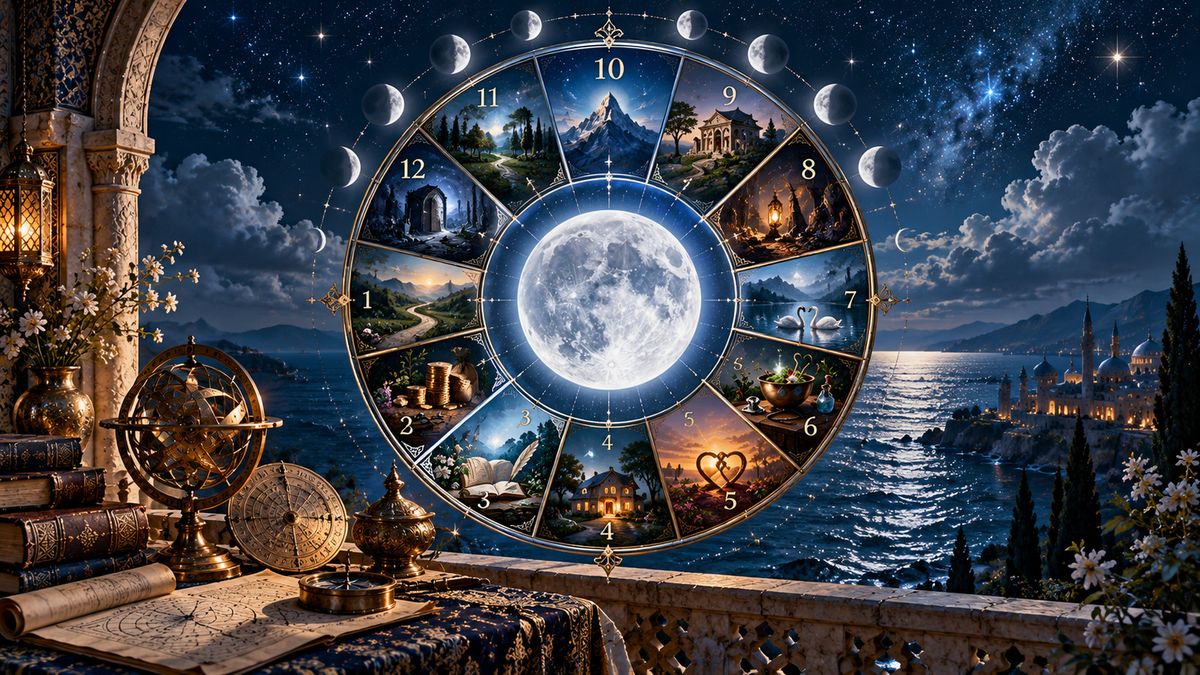
Two people may share the same Moon sign and still receive very different readings in traditional astrology. One may have the Moon in the fourth house, with the symbolism gathered around ancestry and home; another may have it in the tenth, where public obligations become the setting. The Moon sign describes a style of lunar expression, while the Moon house locates that expression within a particular area of life. Neither alone constitutes a complete birth-chart interpretation.
The Moon has long represented change, cycles, nourishment, responsiveness, everyday habits, the public, journeys, and the experience of receiving care. Later psychological astrology gives particular emphasis to emotional needs and the conditions under which a person feels secure. This article examines the Moon in all twelve houses individually, connecting historical symbolism to concrete, carefully qualified examples. The descriptions are traditional interpretive possibilities, not diagnoses, certain personality labels, marriage predictions, or knowledge of the unseen.
For readers new to the framework, RohaniGuide's introduction to the twelve houses explains the houses in general. Here our question is narrower and more useful: what changes when the Moon occupies each house?
1. What Does the Moon Signify in Traditional Astrology?
In older texts the Moon is counted among the seven traditional wandering lights. Its symbolism is not limited to private feelings. William Lilly's seventeenth-century catalogue associates it with travellers, messengers, the general populace, people who work with water and provisions, and figures connected with care and daily necessities. The vocabulary of later astrology adds instinct, attachment, memory, rhythm, and the way a person responds before deliberation. See the annotated account of the Moon's historical significations at Skyscript.
A useful distinction is between the Moon as a significator and the place it occupies. Consider a traveller returning repeatedly to the family home. The Moon contributes movement, recurrence, belonging and changing circumstances; the fourth house contributes land, family foundations and home. Put the same Moon in the third and the symbolism shifts toward repeated local journeys, correspondence and siblings. This is why a house-by-house treatment should not simply repeat the same paragraph twelve times.
The Moon is described as nocturnal in the traditional scheme. Its domicile is Cancer, its exaltation Taurus, its detriment Capricorn, and its fall Scorpio. These are sign conditions, not house placements. A person with the Moon in Taurus does not automatically have a second-house Moon; a Moon in Cancer does not automatically occupy the fourth house. The distinction is recorded in both Astrodienst's traditional dignity table and the Skyscript Moon reference.
| Traditional consideration | What it means | What it does not mean |
|---|---|---|
| Moon sign | Zodiac sign containing the Moon | The Moon's house number |
| Moon house | Life domain containing the Moon | An inevitable event in that domain |
| Domicile: Cancer | Traditional sign rulership | Moon must be in house four |
| Exaltation: Taurus | Traditional sign of exaltation | Moon must be in house two |
| House of joy: third | Traditional affinity with messages and journeys | The third house guarantees happiness |
2. Why the Moon's Traditional House of Joy Is the Third
An easily missed historical point is that the Moon rejoices in the third house. The Sun's house of joy is the ninth, Venus's is the fifth, and the Moon's is the third. In the old scheme of planetary joys, the third is associated with siblings, messages, neighbourhoods, and shorter journeys—an apt setting for a fast-moving luminary linked with travellers and messengers. Deborah Houlding's discussion of planetary joys and Skyscript's glossary document this historical placement.
Certain Hellenistic sources gave the third house a mythological title sometimes translated as the House of the Goddess. That is a historical label within Greco-Roman astrology, not a religious title to adopt or an object of devotion. The point for this article is simpler: the older system assigns the Moon a particular affinity with the third, not the fourth or fifth. The fourth can still be significant for lunar symbolism because it concerns the home, but it is not the Moon's classical house of joy.
Being in a house of joy is also not a universal guarantee of ease. The condition of the Moon's sign, its aspects, phase, ruler, and other chart testimonies still matter inside the traditional technique. A person may have a third-house Moon and find that family conversations are central but emotionally complicated rather than effortless.
3. Moon in the First House: Feelings That Become Visible
Core theme: identity, bodily presence, first impressions, the way one meets the world. In a first-house Moon reading, responsiveness is brought close to the Ascendant. Traditional interpreters look for a person whose changing circumstances, daily routines or concern for others become highly visible. Modern readings often say feelings quickly reach the face or voice: the person may respond to the atmosphere of a room before articulating what has changed.
Potential strength: adapting to different people, noticing unspoken needs and making contact without ceremony. Possible tension: allowing every passing mood or outside reaction to determine one's self-image. The placement is not a promise of sensitivity, physical appearance, or an illness; the Moon's condition and the Ascendant ruler change the interpretation.
Example: A teacher may be known for adjusting the tone of a classroom almost immediately when pupils become unsettled. The same habit can be tiring when the teacher interprets everyone's discomfort as a personal responsibility. A fuller reading asks whether the first-house Moon is supported or challenged by aspects and what sign it occupies.
4. Moon in the Second House: Security, Resources and Changing Priorities
Core theme: possessions, income, livelihood and what is considered valuable. Here the Moon's symbolism of cycles and everyday needs meets the house of material resources. Older astrologers would examine money, food and provisions; contemporary interpreters may additionally discuss how financial steadiness is connected with emotional comfort. Neither reading means someone's earnings must fluctuate.
Potential strength: practical responsiveness to a household's needs, attention to supplies, and an ability to revise priorities when conditions change. Possible tension: seeking reassurance through purchases or treating a temporary shortage as a verdict on self-worth. The second house cannot establish whether a person is rich, poor or destined for loss from the Moon alone.
Example: One family member keeps a flexible food-and-expense budget, sensing when a change in work hours requires different spending. The symbolism concerns the relationship between care and resources, not an invented forecast about profit, debt or a specific financial date.
5. Moon in the Third House: Siblings, Messages and the Moon's Joy
Core theme: siblings, neighbours, correspondence, everyday learning and shorter journeys. This is the Moon's traditional house of joy. A third-house Moon ties recurring lunar themes to the immediate social world. Old texts connect the Moon with messengers and travellers; the third house therefore provides one of the clearest combinations of planet and place.
Potential strength: an ear for how messages are received, ease in checking on relatives, keeping a neighbourhood connected, or giving familiar stories a living voice. Possible tension: absorbing every argument between siblings, repeatedly revisiting old conversations, or feeling compelled to respond to every message. Joy here describes symbolic affinity, not a life free from disagreement.
Example: A person becomes the unofficial bridge between relatives living in different streets, remembering who needs a call, a visit, or news about an elder. If a difficult aspect accompanies this Moon, the same intermediary role may also become exhausting. The chart cannot establish the number of siblings or their fate.
6. Moon in the Fourth House: Home, Roots and Private Foundations
Core theme: residence, land, ancestral background, family foundations and private life. The fourth is a powerful angular house. In many older Western sources it is connected with parents in general and the father in particular; later schools also often associate the Moon and the fourth with maternal care. Those conventions should not be mistaken for a single universal rule about which parent a house represents. See Skyscript's historical fourth-house discussion.
Potential strength: preserving a sense of belonging through changes of residence, safeguarding family stories, or creating a place where people can rest. Possible tension: feeling responsible for everyone at home, over-identifying with childhood circumstances, or experiencing an intense pull between privacy and outside demands. This placement cannot reveal whether a parent will live, die, reconcile or move away.
Example: Someone living abroad maintains rituals of hospitality learned in childhood. Their rented flat gradually becomes the gathering place for friends who have no family nearby. The interpretation centres on what home means and how it is remade, not on a fixed prediction about property ownership.
7. Moon in the Fifth House: Delight, Children and Creative Expression
Core theme: pleasures, children, play, enjoyment and voluntary creative activity. A fifth-house Moon is commonly interpreted through experiences that bring warmth and an opportunity to care freely. A writer may return repeatedly to storytelling; a parent may find shared games deeply meaningful. In the historical planetary-joy arrangement Venus, not the Moon, rejoices in this house.
Potential strength: nourishing creativity, recognising when loved ones need play rather than instruction, and allowing affection to appear naturally. Possible tension: depending on external praise for emotional reassurance or carrying a loved one's disappointments as one's own. The Moon in the fifth cannot certify fertility, the number or sex of children, or the outcome of a relationship.
Example: A craftsperson makes changing seasonal collections, not because inspiration is constantly available but because recurring family celebrations suggest new designs. The Moon's cyclic quality is interpreted through the fifth house's creative and celebratory setting.
8. Moon in the Sixth House: Everyday Service, Work and Strain
Core theme: duties, hired work, service, illness and burdens in the older house tradition. Modern astrology sometimes adds routine, habits, colleagues and the workday. The Moon here can describe care expressed in repeated practical tasks: preparing meals, maintaining supplies, coordinating shifts, or supporting someone who depends on consistent help.
Potential strength: noticing small needs before they become neglected and giving regular service dignity. Possible tension: placing every other person's routine ahead of one's own rest, or confusing being useful with being valued. In old texts the sixth is not inherently an easy house, but a sixth-house Moon is not a medical diagnosis and cannot predict an illness.
Example: A coordinator in a community kitchen remembers which volunteers need shorter shifts and which deliveries must leave early. The illustration concerns attention to practical rhythms; for questions about health or treatment, a birth chart is no substitute for qualified care.
9. Moon in the Seventh House: Partnership and Emotional Reciprocity
Core theme: marriage, committed relationships, contracts, clients and open counterparts. The seventh is an angular house concerned with the people one meets opposite oneself. The Moon may be read as making mutual response and the everyday give-and-take of a partnership especially noticeable. Historical house texts also include commercial dealings and opponents; the seventh is not exclusively romantic. See Skyscript's seventh-house account.
Potential strength: recognising when a partner's needs shift and preserving a conversation across changing circumstances. Possible tension: interpreting silence as rejection, or expecting a partner to regulate every feeling. The seventh-house Moon alone cannot tell whether someone will marry once or twice, whom they will marry, or whether a relationship will survive.
Example: Two business partners agree to review workloads every month because their circumstances alter with the season. The Moon illustrates changing needs within an agreement, not a guarantee of marital harmony.
10. Moon in the Eighth House: Inheritance, Trust and Uncertainty
Core theme: mortality, other people's assets, inheritances and difficult obligations in older sources; shared finances and psychological vulnerability in many modern readings. These layers are related but not identical. A careful interpreter states which tradition is being used instead of quietly inserting modern phrases into a supposedly ancient text.
Potential strength: being able to discuss sensitive responsibilities, help administer family resources transparently, or face uncertainty without avoiding every difficult conversation. Possible tension: becoming absorbed in fears about loss or carrying other people's liabilities emotionally. The eighth-house Moon is not a sign that someone will die early, inherit wealth, or experience a fixed crisis.
Example: Siblings handling an elderly relative's estate may find that every financial discussion also brings family memories to the surface. Here the interpretation concerns emotional layers around shared obligations, not a prediction of inheritance or death.
11. Moon in the Ninth House: Belief, Distance and Meaning
Core theme: long-distance journeys, higher learning, religious study, scholarship and searching for meaning. Traditional ninth-house symbolism includes religion, divination, dreams and distant travel. With the Moon here, changing encounters and repeated journeys may inform the way a person learns, teaches, remembers or approaches inherited traditions. The Sun, not the Moon, has its traditional house of joy in the ninth.
Potential strength: openness to learning from different teachers and bringing distant experiences into one's personal understanding. Possible tension: shifting allegiances whenever a new explanation feels emotionally compelling, or assuming a moving experience settles a difficult religious question. A ninth-house Moon does not guarantee migration, spiritual rank, correct doctrine or revelation.
Example: A translator collects oral histories during trips and finds that studying language deepens respect for the communities encountered. The Moon's receptivity is interpreted through the ninth house's journeys and learning.
12. Moon in the Tenth House: Public Roles, Reputation and Duty
Core theme: profession, action in public, reputation, honours and responsibility. With the Moon in the tenth, the old association with crowds and public visibility meets the chart's career-and-standing house. A person might be known for work that responds to changing public needs or for providing continuity when an organisation undergoes transition.
Potential strength: understanding the human consequences of institutional decisions and making leadership attentive to ordinary lives. Possible tension: allowing public approval to set emotional priorities, or feeling unable to retreat from a visible role. A tenth-house Moon is not a promise of celebrity, government employment or a managerial post.
Example: A neighbourhood organiser becomes widely recognised because she changes community activities when families' schedules change. The chart symbolism concerns responsiveness in public service, while the outcome depends on real work, people and circumstances.
13. Moon in the Eleventh House: Friends, Allies and Shared Hopes
Core theme: friends, patrons, alliances, community support and hoped-for benefits. Older authors called the eleventh a fortunate place and associated it with benefactors; modern readings add collectives and networks. The Moon may signify emotional investment in companionship, mutual care and the changing needs of a group.
Potential strength: noticing who has gone quiet in a friendship circle and sustaining cooperation through ordinary acts. Possible tension: feeling pulled between several groups, making belonging dependent on constant agreement, or expecting all friends to respond with the same intimacy. Jupiter—not the Moon—has its classical house of joy in the eleventh.
Example: An alumni group raises emergency assistance for a member. Someone with an eleventh-house Moon, in this interpretive illustration, may be especially engaged with the rhythm of communal support. This does not establish that financial help will always arrive.
14. Moon in the Twelfth House: Solitude, Hidden Pressures and Compassion
Core theme: isolation, confinement, hidden adversities and withdrawal in older texts; solitude, retreat and unseen emotional labour in later interpretations. The traditional twelfth is a difficult house, so it would be misleading to label it automatically mystical or fortunate. Yet its symbolism can also be discussed through the way care is offered quietly, outside recognition.
Potential strength: compassion for people who are overlooked, private reflection, and a willingness to assist where publicity is inappropriate. Possible tension: keeping distress hidden, feeling responsible for situations beyond one's control, or withdrawing instead of seeking support. A twelfth-house Moon does not prove secret enemies, possession, mental illness, or a supernatural event.
Example: A volunteer offers discreet companionship to people in long-term care. The Moon's nurturing language appears in an environment the twelfth house has historically associated with seclusion. That is an analogy, not an assessment of the volunteer's health or future.
15. Twelve Moon Houses at a Glance
| House | Main traditional territory | Particular lunar question |
|---|---|---|
| 1st | Self, presence, appearance | How is responsiveness expressed openly? |
| 2nd | Resources, possessions | What role does material security play? |
| 3rd | Siblings, messages, local travel | How does care travel through communication? |
| 4th | Home, roots, parents | Where is a sense of belonging cultivated? |
| 5th | Children, pleasure, creation | How is affection expressed through joy? |
| 6th | Work, service, burdens | How does care shape daily obligations? |
| 7th | Marriage, agreements, others | How are changing needs negotiated together? |
| 8th | Legacies, loss, obligations | How is uncertainty carried with others? |
| 9th | Learning, religion, distance | What experiences reshape understanding? |
| 10th | Career, status, public action | How does care appear in public duty? |
| 11th | Friends, supporters, hopes | How is belonging maintained in a group? |
| 12th | Solitude, hidden difficulty | How is compassion expressed quietly? |
The table is a reading map, not a ranking of good and bad placements. Angular houses (first, fourth, seventh and tenth) are traditionally considered prominent; succedent houses (second, fifth, eighth and eleventh) hold or develop matters; cadent houses (third, sixth, ninth and twelfth) are more removed from angles. None of those labels overrides the Moon's whole condition.
16. Moon Sign, House and Phase: Three Different Questions
People commonly ask whether Moon in Cancer is the same as Moon in the fourth house. It is not. Signs describe the Moon's zodiacal condition or style; houses describe the territory where that symbolism is read; phase describes the Moon's changing angular relationship to the Sun. A waxing Moon and a waning Moon may therefore share the same house but receive different traditional emphases.
| Component | Example | Interpretive focus |
|---|---|---|
| Moon sign | Moon in Cancer | Domicile; lunar style and sign condition |
| Moon house | Moon in seventh | Partnership as the setting |
| Moon phase | Waxing or waning | Growth or release in some traditions |
| Moon aspects | Trine or square to another planet | How two symbols are brought into relation |
| House ruler | Ruler of the Moon's occupied house | Context supplied by another chart factor |
The phase does not by itself tell an astrologer whether a marriage or birth will occur, and a square is not a verdict of misfortune. The Astrology Podcast's historical discussion of the Moon provides useful background on the importance of context, sect and lunar condition.
17. Worked Example: Why Two House Systems Can Place the Same Moon Differently
Imagine an illustrative chart, not a real person's computed nativity, with an Ascendant at 25° Sagittarius and the Moon at 8° Sagittarius. The signs and degrees are given solely to demonstrate house division.
In Whole Sign houses, the entire sign of Sagittarius is house one. The Moon at 8° Sagittarius therefore falls in the first house. In Equal houses, the first-house cusp begins at the Ascendant degree, 25° Sagittarius, and each cusp lies 30° after the previous one. The twelfth-house cusp is 25° Scorpio; its span continues to 25° Sagittarius. The Moon at 8° Sagittarius thus falls in the twelfth house under that system.
| Chart element | Whole Sign | Equal House |
|---|---|---|
| Ascendant | 25° Sagittarius | 25° Sagittarius |
| Moon | 8° Sagittarius | 8° Sagittarius |
| First-house start | 0° Sagittarius | 25° Sagittarius |
| Twelfth-house span | Entire Scorpio | 25° Scorpio to 25° Sagittarius |
| Moon's assigned house | First | Twelfth |
Arithmetic check: from 25° Scorpio to 25° Sagittarius is 30°; 8° Sagittarius lies 13° beyond 25° Scorpio, inside that twelfth-house interval. No lunar longitude has changed. Only the house boundary convention has. For the definition of Whole Sign houses, see Astrodienst's overview of house systems.
This is also why accurate birth time and location matter in house interpretation. If the birth time is uncertain, the Ascendant and house cusps may be uncertain. A report should state that limitation instead of disguising a guessed hour as an exact birth chart.
18. How to Read a Natal Moon Without Flattening It Into a Slogan
A more careful traditional reading begins by identifying the Moon's sign and degree, then locating its house under a named house system. The interpreter considers whether the Moon is angular, succedent or cadent, whether it is waxing or waning relative to the Sun, and whether major aspects involve the Moon. The relevant house ruler and the broader chart add context. These considerations can reinforce one another or point in different directions.
For example, Moon in the seventh house may suggest relationships are a prominent theme within the symbolic framework. But if the sign, its ruler, and aspects complicate that reading, “you are guaranteed a happy marriage” is not a defensible conclusion. Likewise, Moon in the sixth does not license a diagnosis and Moon in the eighth does not license predictions of death or inheritance.
The best educational use of such interpretations is to ask specific, non-fatalistic questions: Is care being expressed through work or companionship? Does a person's sense of belonging revolve around a household or a wider community? Such questions preserve the distinctive language of the tradition without pretending that a single placement dictates another person's life.
19. Classical and Modern Interpretations: Where They Differ
Historical house meanings are not identical to their twenty-first-century psychological counterparts. Later writers often expand lunar symbolism toward private feeling and attachment while older manuals give more attention to people, places, household goods, journeys and concrete questions. Both may be described, but they should be labelled honestly.
| Placement | Older emphasis | Common later emphasis |
|---|---|---|
| Moon in 3rd | Messengers, siblings, short journeys; Moon's joy | Emotional communication, familiar bonds |
| Moon in 4th | Parents, land, household foundations | Inner security, childhood belonging |
| Moon in 6th | Service, labour and illness questions | Habits, work rhythm, caring through routine |
| Moon in 8th | Legacies, death, obligations | Trust, shared resources, vulnerability |
| Moon in 12th | Confinement, enemies, hidden difficulties | Privacy, retreat, inner burdens |
This contrast does not make every late interpretation wrong or every old description personally applicable. It simply prevents the common mistake of presenting a modern psychological theme as though it were a quotation from an ancient author.
20. Frequently Asked Questions
Is Moon in the third house automatically lucky?
No. It occupies the Moon's traditional house of joy, a symbolic affinity recorded in historical astrology. How the house is interpreted still depends on lunar condition and other chart factors; no outcome is guaranteed.
Does Moon in the seventh house guarantee marriage or divorce?
Neither. The seventh concerns partnership and agreements, but no single placement determines whether, when, or to whom a person marries.
Does Moon in the fourth house always refer to the mother?
No. Traditions differ over parental significators. Many older Western accounts associate the fourth house with fathers or parents generally, while later interpretations frequently bring in the mother and emotional upbringing. State which convention is being used.
Can Moon in the eighth or twelfth house predict danger or illness?
No responsible reading should treat either placement as proof of illness, harm, death or hidden enemies. They are broad historical house symbols, not a medical or legal assessment.
What if my birth time is unknown?
Your Moon's zodiac sign may be estimated from the date and an ephemeris, but the house cannot safely be asserted without an adequately established Ascendant. If the Moon crosses a sign boundary that day, even the sign may need a time range. Mark uncertainty rather than invent precision.
Should I use Whole Sign, Equal or Placidus?
They are different house-division conventions. A transparent interpretation names the chosen system and, where a planet changes houses between methods, says so. Changing house systems does not change the Moon's actual zodiac longitude.
21. Closing Reflection: The Moon Changes Its Setting, Not Its Nature
Across these twelve houses, the Moon remains a symbol of rhythms, care, movement, memory and responsiveness. In the first house those themes may be brought to personal presentation; in the third, the message carried to a sibling; in the fourth, the hearth; in the seventh, an agreement that must accommodate two lives; in the tenth, a public responsibility. The value of a nuanced traditional reading is in how precisely it connects a symbol to its setting, not how confidently it claims to predict someone else's destiny.
For foundational house meanings, revisit the twelve houses explained on RohaniGuide. For historical material on the lunar significator, planetary joys and different house arrangements, explore the references below.
Sources and Further Reading
- Skyscript — The Moon: Traditional attributes, adapted from William Lilly.
- Deborah Houlding — The Houses of Planetary Joy.
- Skyscript — Joys of the Planets glossary.
- Astrodienst — Domicile and traditional dignity table.
- Skyscript — The Fourth House: Roots, Parents and Land.
- Skyscript — The Seventh House: Partnership and Contracts.
- Astrodienst — Overview of house systems.
- The Astrology Podcast — The Moon in Astrology: Meanings and Uses.